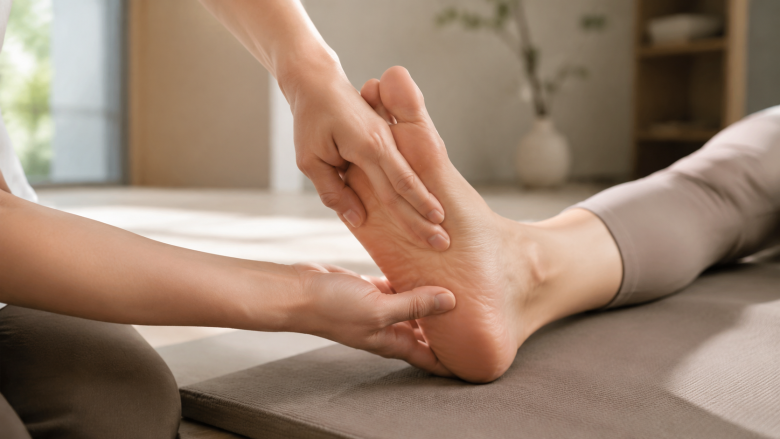
The Problem With Forceful Plantar Fasciitis Exercises
If you have plantar fasciitis, you have probably been told to stretch aggressively, roll a frozen water bottle under your foot until you wince, or push through the pain of a towel pull. When I first developed heel pain, I did all of those things. I made it worse.
The thing nobody tells you about plantar fasciitis is that the fascia is not a muscle. It does not respond well to being torn, stretched, or crushed. It is a dense band of connective tissue that needs to glide, hydrate, and gradually reload - not be forced into submission.
Gentle movement for plantar relief is a different approach entirely. It is slow, mindful, and pain-free. It calms your nervous system first, then re-educates your foot through micro-motion. This article will show you exactly how to do that, step by step.
Core principle: If it hurts, you are doing too much. The goal is to ease into healing, not push through discomfort.
Why Gentle Movement Works When Stretching Fails
Most standard plantar fasciitis protocols focus on static stretching of the calf and the plantar fascia itself. The logic seems sound: tight calf muscles pull on the heel, so stretching should help. But there is a problem with this logic that becomes obvious when you actually work with the tissue.
When you perform an aggressive stretch on an already irritated fascia, you create micro-tears in a tissue that is already inflamed. Your body responds by laying down more scar tissue and increasing tension to protect the area. This is why so many people report that their heel pain gets worse the day after a rigorous stretching session.
Gentle movement takes the opposite path. Instead of forcing the tissue to lengthen, you encourage it to slide and glide naturally. This is called fascial glide, and it is a completely different physiological process than stretching. Fascial glide focuses on the space between tissue layers, not the length of the tissue itself.
When I started working with clients who had chronic heel pain, I noticed that the ones who recovered fastest were not the ones who stretched the most. They were the ones who moved slowly, breathed deeply, and never pushed into pain. Their nervous systems calmed down, which allowed the tissue to release on its own.
The Nervous System Connection Nobody Talks About
Plantar fasciitis is often a pain cycle, not just a tissue problem. When your foot hurts, your brain perceives a threat. Your nervous system responds by increasing tension in the surrounding muscles to protect the area. This creates more pull on the fascia, which creates more pain, which creates more tension.
This is why reducing cortisol and tension before you even touch your foot matters. Slow, rhythmic movement signals safety to your nervous system. It tells your brain that there is no threat, so it can stop guarding the tissue.
I have seen clients who could barely walk in the morning, and after five minutes of gentle seated ankle circles, their pain dropped by half. Nothing structural changed in five minutes. What changed was their nervous system's interpretation of the threat.
Getting Started: The Setup for Gentle Movement
Before you begin any movement sequence, you need to create the right conditions. This is not about willpower or pushing through. It is about setting yourself up for success.
Find a quiet space where you will not be interrupted. Sit in a comfortable chair with your feet flat on the floor. If you are very tight, you can sit on a cushion to elevate your hips slightly. Wear loose socks or go barefoot - you need to feel the floor.
Take three slow breaths. Inhale through your nose for four counts, exhale through your mouth for six counts. This extended exhale is the fastest way I know to drop your heart rate and signal safety to your nervous system.
When I first started practicing this, I made the mistake of rushing through the breath work because I wanted to get to the exercises. That was backwards. The breath work is the most important part. Without it, the movements are just more mechanical stretching.
How to Know If You Are Doing It Right
The single most important rule for gentle movement for plantar relief is this: you should never feel pain. Not a stretch, not a burn, not a discomfort. If you feel any of those sensations, you have gone too far and you need to reduce the range of motion.
What you should feel is a sense of ease. Your foot should feel like it is waking up, not being worked on. Some people describe it as a pleasant warmth or a feeling of space in the joint. If you feel nothing, that is also fine, especially in the beginning.
I tell my clients to imagine they are moving their foot through warm honey. That mental image helps you slow down and move with intention, rather than rushing through the motions.
The Core Sequence: Soft Tissue Glides for the Foot
This sequence is the foundation of my approach to gentle movement for plantar relief. It takes about 10 to 15 minutes, and it can be done anywhere you can sit down. You do not need any equipment, although a comfortable chair makes it easier.
Do this sequence once in the morning before you put weight on your foot, and once in the evening before bed. If you have a sedentary job, you can also do a shortened version mid-day.
1. Slow Ankle Circles
Sit with one foot lifted off the floor. Begin tracing slow circles with your toes, as if you are drawing a large circle in the air. The circle should be small enough that you feel no strain in your ankle or calf.
Do 5 circles clockwise, then 5 counterclockwise. Keep your breath slow and even. Most people rush this. They make the circle too big and too fast, which turns it into a stretch. The goal is a micro-motion, not a full range of motion exercise.
When I first started, I made my circles too large and ended up with a sore ankle. I learned to think of it as moving the foot through a puddle, not drawing a hula hoop.
2. Toe Spreading and Relaxing
Place your foot flat on the floor. Very slowly, try to spread your toes apart from each other, as if you are making your foot wider. Do not force it. Just attempt the movement and see how far your toes naturally go.
Hold the spread for a breath, then slowly relax. Repeat 8 to 10 times. Most people's toes barely move when they first try this, especially if they have been wearing narrow shoes for years. That is okay. The movement is about re-establishing the neural connection, not about achieving a big spread.
This exercise is deceptively difficult. It activates the intrinsic muscles of the foot, which are the small muscles that support your arch. These muscles are often weak and underused, which is a root cause of plantar fasciitis for many people.
3. Heel-to-Toe Rocking
With your foot flat on the floor, begin slowly shifting your weight from your heel to the ball of your foot. The movement should be tiny - just a few millimeters. You are not doing a calf raise. You are just rocking gently.
Do this for 10 slow repetitions. Focus on the sensation in the bottom of your foot. You are encouraging the fascia to glide and lengthen naturally through weight shifting, without forcing a stretch.
This is the first movement that starts to reintroduce load to the foot. It is a bridge between the purely passive movements and the more active strengthening work you will do later.
4. Arch Lifts Without Toe Curling
This is the most subtle movement in the sequence, and also the most powerful. Keep your toes relaxed and flat on the floor. Now, without curling your toes, try to lift the arch of your foot upward, as if you are creating a dome under your foot.
Most people will instinctively curl their toes to do this. That is cheating. The movement comes from the muscles in the arch itself, not from the toes. It is a very small movement, but it is the foundation of proper foot function.
Hold the lift for a breath, then slowly lower. Repeat 10 times. When I first learned this exercise, I could not do it at all. My toes would curl every single time. It took weeks of practice before I could isolate the arch muscles. Be patient with yourself.
5. Gentle Foot Rocking With Breath
Stand up and hold onto a counter or wall for balance. Place your feet hip-width apart. Begin to slowly shift your weight forward onto your toes, then back onto your heels. Keep the movement small and rhythmic.
Coordinate your breath with the movement: inhale as you rock forward, exhale as you rock back. Do 10 slow repetitions. This movement is particularly good for people who have been avoiding weight-bearing activity because it reintroduces load gradually.
This is the closest thing to walking that you will do in this sequence, but it is much slower and more intentional. It teaches your foot to accept weight without bracing or guarding.
Breath and Tension Release: The Missing Half of Healing
Every exercise above will work better if you pair it with deliberate breathing. This is not optional. It is a physiological necessity for pain relief.
When you are in pain, your body is in a sympathetic state - fight or flight. Your muscles are primed for action, your blood vessels are constricted, and your pain receptors are sensitized. Deep breathing activates the parasympathetic nervous system, which is the rest and digest state. This lowers cortisol, dilates blood vessels, and reduces pain perception.
I have a client who was convinced that no exercise would help her plantar fasciitis. She had tried everything: cortisone shots, night splints, custom orthotics, aggressive stretching. Nothing worked. When we started doing gentle movement with breath work, she was skeptical. But after three weeks, her morning pain went from an 8 out of 10 to a 3 out of 10, just from the breathing and micro-movement.
She did not change anything else about her routine. The only variable that changed was that she stopped forcing her foot to stretch and started teaching it to relax.
The 4-6 Breathing Pattern
The specific breathing pattern matters. I use a 4-6 pattern: inhale for 4 counts, exhale for 6 counts. The longer exhale is what activates the parasympathetic nervous system.
Try this: inhale through your nose for 4 counts, then exhale through your mouth for 6 counts. Do this for 2 minutes while you are doing your ankle circles. You will notice that your shoulders drop, your jaw relaxes, and your foot feels less tense.
If you want to incorporate this into a broader routine, our daily gentle movement routine for women's wellness has a full breath work section that pairs well with foot exercises.
Pacing and Recovery: How to Avoid Flare-Ups
The standard advice for plantar fasciitis exercises is to do them 4 to 6 times a day. That advice ignores the reality of flare-ups. When your foot is already angry, doing exercises multiple times a day can keep it in a constant state of irritation.
I recommend a different approach based on your current pain level. Think of it as a traffic light system.
Red light (acute flare-up): Your foot hurts even at rest or with the first step in the morning. Do only the breath work and ankle circles. Skip the toe spreading and arch lifts. Your goal is to calm the nervous system, not to strengthen the foot. Do this 1 to 2 times a day.
Yellow light (moderate pain): Your foot hurts when you stand up, but the pain eases as you move. Do the full sequence once a day, plus the ankle circles a second time if you feel up to it. Do not add any additional walking or standing exercise.
Green light (mild or no pain): You can do the full sequence once or twice a day, and you can start adding the strengthening exercises below. This is the time to build resilience, not just manage symptoms.
The Two-Day Rule
Here is a rule I give all my clients: if you have a flare-up after doing your gentle movement routine, it means you did too much. Reduce the number of repetitions by half and the range of motion by half. Then wait two days before you increase again.
This two-day rule prevents the boom-and-bust cycle that keeps people stuck. You do a lot, your foot flares up, you stop completely, your foot feels better, you do a lot again, your foot flares up again. It is a miserable cycle, and it is avoidable.
I have been guilty of this cycle myself. I would feel good for a few days and then ramp up my activity, only to be back on the couch with ice packs. The two-day rule forced me to be patient, and it was the single most effective change I made.
Progressive Loading: Strengthening the Foot Long-Term
Once your pain is under control, the next step is to strengthen the foot so the problem does not come back. Gentle movement for plantar relief is not just about managing pain. It is about re-educating the foot to function properly.
The exercises below are more advanced than the soft tissue glides. Add them only when you are in the green light phase, and add them one at a time.
Toe Splay With Resistance
Once you can spread your toes easily on the floor, you can add resistance. Place a thick rubber band around your toes and practice spreading them against the band. Do 10 repetitions. This strengthens the intrinsic muscles that support your arch.
This exercise addresses a root cause of plantar fasciitis: weak foot muscles. When your intrinsic muscles are weak, your plantar fascia has to do all the work of supporting your arch. Over time, that overwork leads to irritation and pain.
Single-Leg Balance
Stand near a counter for support. Lift one foot slightly off the floor and balance on the other foot. Hold for 30 seconds. This trains the small stabilizing muscles in your foot and ankle.
If 30 seconds is too hard, start with 10 seconds and work up. The goal is not to be a great balancer. It is to wake up the proprioceptive feedback loop between your foot and your brain.
I recommend adding this exercise to your routine before you start any high-impact activity like running or jumping. A foot that cannot balance cannot safely absorb impact.
Slow Calf Raises
Stand with your feet flat on the floor. Slowly rise onto your toes, taking a full 3 seconds to go up. Hold at the top for a breath, then take 3 seconds to lower back down. Do 5 repetitions.
The slow tempo is what makes this a strengthening exercise rather than a stretch. You are loading the calf and the Achilles tendon, which both attach to the plantar fascia. Strengthening these structures takes tension off the fascia itself.
For a deeper dive on how to build a daily movement practice that supports your feet and your whole body, see our 7-day gentle movement plan for beginners.
Common Mistakes and How to Avoid Them
Even with the best intentions, people make mistakes that keep them stuck in pain. Here are the most common ones I see, and how to avoid them.
Mistake 1: Treating gentle movement as a stretch. If you are pushing into a strong sensation, you are stretching, not gliding. Back off. The movement should feel easy, almost boring. If it feels like work, it is too much.
Mistake 2: Doing too much too soon. I know it is tempting to add all the exercises at once because you want to get better faster. But the foot responds to consistency, not intensity. Add one new exercise per week at most.
Mistake 3: Ignoring footwear. You can do all the gentle movement in the world, but if you are walking around in flat, rigid shoes or going barefoot on hard floors all day, you are fighting an uphill battle. Supportive shoes with a slight heel drop make a meaningful difference.
Mistake 4: Expecting immediate results. Gentle movement works, but it works slowly. Most people notice a difference in 2 to 4 weeks, not 2 to 4 days. If you are looking for a quick fix, this approach will frustrate you. If you are looking for a lasting fix, it is the most reliable path I know.
When to Seek Professional Help
Gentle movement for plantar relief is effective for many people, but it is not a substitute for medical care. You should see a healthcare provider if any of the following apply to you.
Your pain does not improve after 6 to 8 weeks of consistent gentle movement. Your foot is swollen, red, or warm to the touch, which can indicate an infection or a stress fracture. You have numbness or tingling in your foot, which can indicate nerve involvement. You cannot put any weight on your foot at all.
A physical therapist can assess your specific biomechanics and create a tailored program. A podiatrist can rule out other conditions like tarsal tunnel syndrome or a heel spur that may require different treatment.
According to the American Physical Therapy Association, physical therapy is a first-line treatment for plantar fasciitis, and a therapist can guide you through progressive loading safely.
Building a Sustainable Practice
The most important thing I have learned from working with my own foot and with clients is that healing is not a sprint. It is a slow, steady process of re-education.
You are not just trying to get rid of pain. You are teaching your foot to move differently, to load differently, and to respond to stress without bracing. That takes time. But the skills you build will serve you for the rest of your life.
Start with the 5-movement sequence above. Do it every day for two weeks, even if you do not think it is working. Then reassess. You will likely find that your morning pain is less intense, your foot feels more mobile, and you are not dreading the first step out of bed.
For a structured approach to building this into your day, I recommend pairing this foot work with the gentle daily stretches for flexibility guide, which covers the rest of the body.
Remember: the goal is not to conquer your foot. It is to listen to it, support it, and let it heal at its own pace.
The gentle path is not the easy path. It requires more patience and more self-awareness than the aggressive stretching approach. But it is the path that actually works for the long term. Your feet carry you every day. They deserve to be treated with kindness, not force.