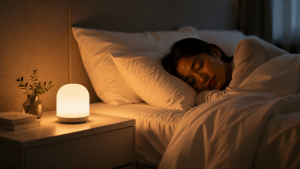
You're awake. Your heart is pounding, and you're trying to remember if the monster under the bed was real. It was a nightmare, and now you're staring at the ceiling, dreading the alarm clock. This is the worst part of the night, but the way you handle the next ten minutes determines how you feel tomorrow and how you sleep tomorrow night.
To sleep better after a nightmare, you must break the immediate fear response, drain the dream of its power through cognitive restructuring, and then strictly follow behavioral rules to re-associate your bed with sleep. This article covers the Cognitive Re--entry Protocol, a method that moves beyond just calming down and actively rewires your brain to prevent the next nightmare.
Why the "Just Relax" Advice Fails You After a Nightmare
Most advice tells you to calm down, take a deep breath, and roll over. But if you have ever tried to tell a racing heart to slow down while your brain is screaming about a threat, you know it doesn't work. The issue is that a nightmare is not just a bad thought; it's a full-body emergency alarm that has been tripped. You need a system, not a wish.
The Physical: You Are Not Just Scared, You Are Aroused
When you wake up from a nightmare, your nervous system is in a state of hyperarousal. Your body is flooded with adrenaline and cortisol, the stress hormones that prep you to run from a bear. Your heart rate is elevated, and your breathing is shallow. This is a physiological event, not just a psychological one.
If you try to go back to sleep while your body is in this state, you are actively fighting your own biology. You can't just "will" your heart rate down. You need to actively signal safety to your body. Most people skip this step and wonder why they toss and turn for an hour. The key is to treat the physical alarm first, because your brain is not in a state to listen to reason until the alarm is silenced.
The Cognitive: Your Brain Is Stuck on "Threat"
Beyond the physical, there is the cognitive loop. The nightmare is a story your brain just wrote, and right now, it's the only story it believes. If you don't give it a different story to hold onto, it will keep playing the scary one on a loop. This is where most advice misses the mark. It tells you to stop thinking about the dream, but it doesn't tell you what to think about instead.
You need to actively replace the narrative, not just suppress it. This is why "just relax" fails. It leaves a void, and your brain will fill that void with more anxiety. The Cognitive Re-Entry Protocol gives you a specific, structured task to replace that fear with agency.
The Cognitive Re-Entry Protocol: A Step-by-Step Guide
This is the framework I developed after years of waking up at 3:00 AM drenched in sweat, feeling like I had run a marathon. I tried the old advice. I did the deep breathing. I drank the chamomile tea. But it wasn't until I stopped trying to ignore the nightmare and started actively confronting it that things changed. This protocol is designed to bridge the gap between the panic of the moment and the long-term work of preventing the next nightmare.
Step 1: The 60-Second Body Scan (Interrupt the Panic Loop)
Before you even think about the dream, you have to get your body out of the panic loop. This is not about breathing to fall asleep; it's about breathing to turn off the fire alarm. I use a 4-7-8 method, but the specific count matters less than the exhalation. Your exhale is the brake pedal for your nervous system.
Here is the exact routine to do the second you sit up. Do not skip this step, even if you feel calm. It takes about 60 seconds.
- Legs over the side: Sit on the edge of your bed with your feet flat on the floor. This is a grounding position that signals to your brain you are in the real world, not the dream world.
- The 4-7-8 Breath: Inhale through your nose for a count of 4. Hold for a count of 7. Exhale slowly through your mouth for a count of 8. The long exhale stimulates the vagus nerve, which is the 'rest and digest' nerve. Do this for four rounds.
- Find five things: After the breathing, look around the room and name five things you can see, four you can touch, three you can hear, two you can smell, and one you can taste. This is a classic grounding technique that pulls you out of the dream's narrative and into the present moment.
When I first tried this, I was skeptical. I remember sitting on the edge of my bed, thinking, "This is too simple to work against the sheer panic." But I was wrong. The key is that it forces your brain to process sensory data in the present moment, which is impossible to do while simultaneously replaying the dream's fear. It's a quick brain reset that allows you to move to the next step from a place of calm, not chaos.
Step 2: The Narrative Rewrite (This Is the Non-Negotiable Part)
Now that your body is calm, it's time to deal with the dream. This is the step that separates this guide from everything else. Most people want to avoid thinking about the nightmare. They want to push it away. But the only way out is through. You are going to rewrite the ending of the dream while you are awake. This is based on a therapeutic technique called Imagery Rehearsal Therapy (IRT), and it is one of the most effective ways to reduce nightmare frequency.
Here is the process: Take a journal or a piece of paper. Do not do this in your head. You need to write it down. Write one paragraph describing the nightmare. Then, write a second paragraph where you change the ending. It doesn't have to make sense. It just has to be different.
For example, if you dreamt you were being chased through a forest by a shadowy figure, you might rewrite the ending where you stop running, turn around, and realize the figure is actually a lost mailman holding a package for you. Or, you might imagine the forest floor turns into a trampoline and you bounce away to safety. It sounds silly, and that is exactly the point. The logic center of your brain is offline during REM sleep. By adding a nonsensical, silly, or powerful element, you are teaching your brain that this memory is not a threat.
Here is what nobody tells you: this is uncomfortable. It is tempting to just write "it was scary" and move on. But the magic happens when you force yourself to be specific. I once had a patient who was haunted by a dream of drowning. We rewrote it so that the water turned to Jell-O, and she could just push it aside to swim. It sounds absurd, but that absurdity is what breaks the fear association. You are training your brain to access a different pathway.
Step 3: The Boring Re-Entry (Behavioral Sleep Rules)
You have calmed your body and rewritten the narrative. Now, it's time to fall back asleep. This is where most people make a critical error. They get back into bed, stare at the ceiling, and wait to fall asleep. When they don't, they get anxious, which makes it harder to sleep. This is where the 20-minute rule comes in, and it is the single most important behavioral rule for anyone who deals with nightmares.
The rule is simple: If you do not fall asleep within 20 minutes of getting back into bed, get up. Get out of bed, go to a dimly lit room, and do something incredibly boring. Do not check your phone, do not watch TV, and absolutely do not start a conversation with your partner. Read a book you have read before. Fold socks. Do a puzzle. The goal is to break the association between your bed and the feeling of being awake and scared.
This is not about sleep hygiene; it's about classical conditioning. You want to train your brain to know that the bed is for sleep, not for lying awake in a panic. If you stay in bed and toss and turn, your brain starts to associate the bed with being awake. You are actively creating a fear of not sleeping, which is just as bad as the fear from the nightmare. I know it sounds counterintuitive. You are exhausted and want to sleep, so getting out of bed seems like a punishment. But I promise you, it works better than lying there.
When I first started using this rule, I hated it. I would be exhausted from a nightmare, and the last thing I wanted to do was get out of my warm bed. But I followed the rule, and within a week, I stopped dreading the night. I knew that if I couldn't sleep, I had a plan. That feeling of control is exactly what your brain needs to let go of fear.
Rewiring Your Brain to Do It All Over Again (Imagery Rehearsal)
The protocol above is reactive; it deals with the nightmare after it happens. The real win, however, comes from using the same principles proactively. This is where we talk about sleep habits, but not the ones you think. I'm not going to tell you to avoid caffeine or put your phone away. You already know that. Instead, let's talk about training your brain to stop the nightmare before it starts.
Imagery Reheersal Therapy (IRT) is not just for the middle of the night. You can and should practice it during the day. Spend 10 minutes during the day, maybe during your lunch break, thinking about the recurring nightmare that is bothering you. Then, imagine the new, rewritten version. You are essentially practicing the new neural pathway. You are rehearsing a new habit for your brain to fall back on.
This is directly connected to your evening routine. If you are looking to deepen your wind-down, you might consider the evening relaxation plan for deeper sleep naturally that we outlined in a previous guide. The goal is to create a comprehensive approach where your brain knows that night time is for safety, not for scanning for threats. This mental rehearsal is a form of practice, just like practicing a sport or a musical instrument. You are teaching your brain to take a different path.
Should You Even Go Back to Sleep? (And Other Burning Questions)
This is a question I get asked constantly, and the answer might surprise you. It depends on your definition of a nightmare and your personal tolerance. If you follow the protocol above and still feel too wired to even attempt sleep, then no, you shouldn't force it. However, if you have calmed down and rewritten the narrative, theres no reason to stay awake. The key is to not be afraid of going back to sleep. The nightmare is a symptom, not a life sentence.
Most people are also curious about the physical side of things. You might be surprised to learn that there is a lot of pseudoscience out there about sleep positions. Let's cut through that. The research on sleep position and nightmares is thin, but the general consensus from sleep specialists is that it is all about breathing and pressure points. If you sleep on your back, you are more likely to experience sleep paralysis, which can be terrifying and feel like being trapped in a nightmare. Side sleeping is generally recommended to keep your airway open and reduce the chance of snoring or sleep apnea, which can fragment sleep and lead to more vivid dreams.
There is no magic sleeping position that prevents nightmares. However, the most common advice is to avoid sleeping on your back if you are prone to sleep paralysis. Ultimately, the best position is the one where you feel most comfortable and safe. If you are constantly worried about the physical position of your body, you are adding another layer of stress to the equation. Choose the position that lets you fall asleep, and you are doing it right.
What is a PTSD nightmare like?
It's important to distinguish between a nightmare and a Nightmare Disorder, especially when we talk about trauma. A regular nightmare is a bad dream. A PTSD nightmare is a completely different beast. It is not just a dream; it is a re-experiencing of the trauma. These nightmares are often described as a high-definition, 3D, sensory flashback. They feel real. The person wakes up in a panic, often in a sweat, and they may be disoriented or confused.
The key difference is the emotional and physiological intensity. In a normal nightmare, you might be chased by a monster. In a PTSD nightmare, you are back in the war zone, or the car crash, or the assault. It is a full-body memory. The brain does not know the difference between the memory and the actual event. This is why it can be so difficult to treat. You are not just dealing with a bad dream; you are dealing with a traumatic memory that is being re-consolidated every time it is recalled. If this sounds like you, please seek professional help, as this is beyond the scope of self-help tips.
Which sleeping position reduces nightmares?
To put it simply, there is no scientific consensus that any single sleeping position is a magic bullet for nightmare prevention. However, there is a strong argument for side sleeping, particularly the left side, for overall sleep quality. Side sleeping reduces the likelihood of sleep apnea and snoring by keeping the airway open. Sleep apnea leads to fragmented sleep and low oxygen levels, which can cause you to wake up frequently, and these micro-arousals can be a trigger for you to remember a nightmare you were just in the middle of.
People often confuse correlation with causation. It is not that side sleeping prevents the nightmare; it is that side sleeping prevents the sleep disruption that makes you more likely to remember the nightmare and feel unrefreshed in the morning. If you are waking up with a jolt from a nightmare, focus on creating a calm, cool, and dark environment. The position is less important than the environment. If you are comfortable, you are less likely to have a disrupted sleep cycle, which is the real culprit behind waking up in a panic.
When It's Not a Nightmare: Understanding Night Terrors
It is crucial to understand that not all night terrors are the same as nightmares, even though the words are used interchangeably. They are actually polar opposites in the sleep world. A nightmare happens during REM, the dreaming stage of sleep, and is characterized by a vivid story that you remember. A night terror, on the other hand, happens during non-REM sleep, usually in the first few hours of the night. It is a disorder of arousal, meaning your brain is stuck in a state between sleep and wakefulness.
If you are sleeping next to someone who has night terrors, you know it. They might sit up, scream, and have a panicked look on their face, but they are actually in deep sleep. The scary part is that they will not remember it in the morning. If you try to wake them up, they might be confused or even lash out. This is a critical distinction because the advice I gave earlier for a nightmare, like rewriting the narrative, does not work for night terrors because there is no narrative to rewrite.
For night terrors, the treatment is entirely different. It is often about addressing the underlying trigger, like sleep deprivation or stress. In some cases, it can be a sign of sleep apnea. If you are having night terrors, you need to see a sleep specialist. Do not just try to ride it out. The difference matters because a nightmare is a psychological event, while a night terror is a neurological one. Treating them the same way is like using a hammer on a screw; it might make contact, but it's not the right tool.
The "20-Minute Rule" and Other Behavioral Rules That Actually Work
We touched on the 20-minute rule earlier, but it is so crucial that it deserves a deeper look. The rule is a cornerstone of Cognitive Behavioral Therapy for Insomnia (CBT-I). It is a behavioral rule designed to break the negative association between your bed and feeling awake. It is not a punishment; it is a reset button. When you have a nightmare, your brain goes into a fear response. If you stay in bed, you are training your brain to associate your comfortable, safe bed with fear and anxiety.
Here is what the rule looks like in practice: You have a nightmare. You do the 4-7-8 breathing and the grounding. You rewrite the narrative. You get back into bed. You close your eyes. You feel that flutter of anxiety. You look at the clock, and it's 2:15 AM. You tell yourself, "I will check the clock at 2:35 AM." You roll over, but you can't stop thinking about the dream. At 2:35 AM, you are still wide awake. At this point, you must get up.
You go to the kitchen, sit in the dark, and read a book on your Kindle. You do not turn on the TV. You do not pick up your phone. You are training your brain to understand that the bed is for sleep. This is a difficult rule to follow, but it is the single most effective way to break the cycle of lying in bed dreading the next scary dream. It takes discipline, but it works. It is a proven method that is a core component of many professional sleep programs.
The Final Word: Your Brain Is a Feature, Not a Bug
Waking up from a nightmare is a jarring experience, but it is not a sign that you are broken. Your brain is not trying to sabotage you. It is trying to protect you. The problem is that the alarm system is a little too sensitive. The Cognitive Re-Entry Protocol is not about silencing your brain; it's about giving it a better job. It is about moving from a place of fear and reactivity to a place of calm and control.
You have the tools to not just survive the next nightmare but to change how you respond to it when it happens and, ultimately, to reduce its frequency. The goal is not to never have a bad dream again, because that is out of your control. The goal is to not be afraid of your own mind. When you take away the fear of the nightmare, you take away its power. You are not at the mercy of your subconscious. You are the one in control, and you can guide yourself back to a restful, peaceful night's sleep.