The Short Answer: Yes, You Can Keep Your Night Light
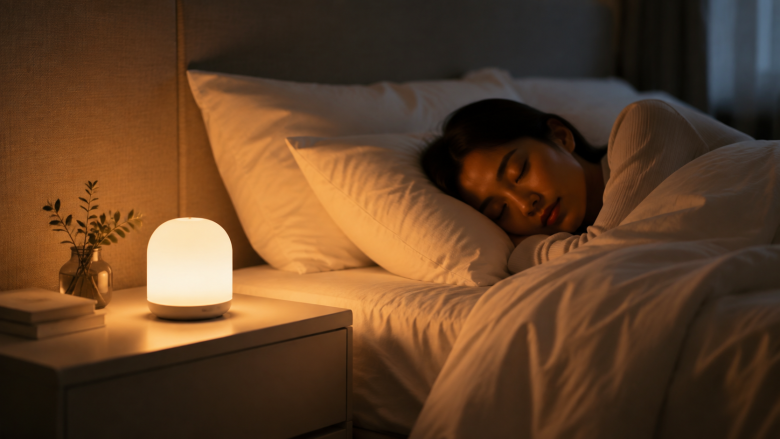
The short answer is yes. You can keep a night light and still sleep well, but only if you get three things right: color, brightness, and placement. A 2-watt white LED plugged into a wall socket next to your head will mess with your sleep. A 0.3-watt amber bulb tucked behind a chair near the floor usually won't.
Most advice tells you to eliminate light entirely. That ignores a real problem: some people feel genuinely unsafe in total darkness. That anxious, alert feeling can spike cortisol and keep you awake just as effectively as blue light. The goal is not to force yourself into pitch-black if that makes you miserable. The goal is to design a night light that gives you the comfort and safety you need while minimising the harm to your sleep architecture.
This guide is for the people who need a light on. It's based on what I've learned from years of struggling with sleep anxiety, testing various lights, and eventually working out a setup that lets me fall asleep in a dim, warm glow without waking up groggy.
Why Most Night Lights Sabotage Your Sleep
The main culprit is blue light. When your eyes detect blue-white light at night, your brain's suprachiasmatic nucleus looks at the signal and thinks, "It's daytime." It responds by suppressing melatonin, the hormone that regulates your sleep-wake cycle. A 2019 study published in Current Biology confirmed what sleep scientists have suspected for decades: even low-level light can make it harder to fall asleep and stay asleep. According to Harvard Health, blue light suppresses melatonin for about twice as long as green light and shifts circadian rhythms by twice as much.
But here's what most people don't realize: it's not just the wavelength that matters. It's the intensity and the direction. A faint red glow at floor level won't have the same effect as a bright white lamp shining in your face. The problem with most night lights isn't the existence of the light. It's that they're placed in the worst possible spot - right where you're looking when you're trying to fall asleep.
When I first tried sleeping with a night light, I made every mistake in the book. I bought an LED disc that put out a harsh blue-white glow and plugged it into an outlet directly below my pillow. I wondered why I was waking up at 3 a.m. feeling wired. It takes a bit of trial and error to understand that your night light needs to be treated like a strategic tool, not just a convenience.
The good news is that you can fix it in about ten minutes. Let's go through the rules one by one.
The Color Rule: Red or Amber Only
Color temperature might sound like a fancy technical term, but it's simple. Light on the blue end of the spectrum - roughly 4000K and above - sends "wake up" signals. Light on the red end - 2200K and below - sends "calm down" signals. For a night light, you want the warmest, reddest light you can find.
Red light has a longer wavelength, which your brain interprets as softer and less stimulating. In a 2012 study from the University of Colorado, participants exposed to red light at night had significantly lower melatonin suppression than those exposed to white or blue light. That's why sleep researchers often recommend red or amber bulbs for people who need light in the bedroom.
Look for these specific words when shopping:
- Red glow or amber glow - not "warm white" or "soft white", which are still in the blue-to-yellow range.
- Color temperature listed below 2200K - many red LED bulbs state this on the package.
- Wavelength around 590-630 nm - this is the amber-red range that signals dusk.
Avoid anything with the word "daylight" or "bright white" on the label. Even if it's dimmed, if it's blue-white, it's still a suppressing light. You can test this at home: hold the night light near a white sheet of paper. If the paper looks yellow, orange, or red, you're on the right track. If it looks white or blue, exchange it.
The Brightness Rule: Lower Than You Think
Here's the thing nobody tells you about night lights: the dimmest setting is still often too bright. A typical plug-in night light puts out between 5 and 10 lumens. That might not sound like much, but when your eyes are dark-adapted, even 1 lumen of direct light can suppress melatonin. Research on light exposure and sleep shows that even brief exposure to light of 10 lux can disrupt sleep in some people.
For reference, on a moonlit night, outdoor illuminance is about 0.1 lux. Indoors, a dim night light at floor level might give you 2-3 lux at eye level. That's ideal. If you can easily read a book at arm's length with the night light, it's too bright.
When I set up my current bedroom, I started with a 1-watt red LED bulb. Even that felt like too much. I swapped it for a 0.5-watt amber bulb and placed it behind a floor plant. The light barely spills out, but it's enough to make the room feel less like a void. I can see the outline of my dresser but I can't read a text message across the room.
If you're not sure about the lumen output of your existing light, a simple test is to hold your hand about a foot away from the bulb. If you can clearly see the outline of your fingers, it's too bright for a night light. Your goal is to see shapes and moving objects, not every detail of your arm.
The Positioning Rule: Floor Level, Behind Furniture, Never Facing the Bed
Where you put the light matters more than which light you buy. The worst position is directly in your line of sight. The best positions are all indirect: low, blocked, and angled away from your face.
I used to think it was enough to have a red light. I taped a red bulb into an old desk lamp and placed it on my nightstand, pointed at the wall behind my head. That was still too close. Even the bounce-back from the wall was enough to keep me alert. When I moved the lamp to the floor behind a chair and pointed it at the wall under the window, everything changed.
Here's a practical step-by-step layout you can copy:
- Decide which path you need to see when you get up in the middle of the night. Usually that's the path from the bed to the bathroom or the door.
- Place the light on the floor along that path. Do not put it on your nightstand or on a shelf at mattress height.
- Position something between the light and your bed. A chair leg, a plant, a laundry basket, a low bookshelf - anything that blocks direct line-of-sight from your pillow.
- Angle the light so it shines toward the wall or the floor, not toward your eyes.
- Test it by lying in bed with your eyes open. If you can see the glow of the bulb itself, move it further away or find a taller obstruction.
The goal is to create a soft ambient glow that illuminates the room without ever being directly visible from your pillow. This is the secret to using a night light without ruining your sleep.
When I first set up my system, I forgot one edge case: I kept tripping over the light. It was a small puck-style LED on the floor, and in the dark, I couldn't tell exactly where it was. So I added a motion-sensor feature (more on that below) and put a piece of reflective tape on it. That way it only lights up when I'm getting out of bed, and the reflective tape helps me know exactly where to step.
Smart Night Lights: Motion Sensors, Timers, and Fade-Out Features
If you have trouble remembering to switch the light off, or if you're using a night light to get through a dark hallway, smart features can make your setup even better.
Motion-sensor night lights are ideal for people who only need light for a few moments. They stay dark while you're asleep. When you step out of bed, the sensor triggers the light for 30 to 60 seconds. This gives you enough light to navigate to the bathroom without bathing the room in ongoing light.
For kids, a fade-out schedule is a gentle way to transition them from needing the light on to falling asleep without it. Many smart plugs allow you to set a schedule: the night light stays at full brightness for 20 minutes while they read or fall asleep, then dims gradually over another 15 minutes until it shuts off completely. I've seen this work wonders for children who are afraid of complete darkness. The trick is to make the fade slow enough that they don't notice it.
Timers are another option. If you know you're anxious for the first night after a stressful event, set a timer for 60 minutes. Once the light turns off, you've probably already fallen asleep. If you wake in the middle of the night needing light, a motion-sensor light at the floor level is the perfect backup.
The Hotel Hack: Dim Bathroom Light With a Door Crack
If you travel, you rarely have the luxury of packing a perfect red night light. That's where the hotel bathroom hack comes in. This is a trick I've used on every business trip for the past three years.
Leave the bathroom light on and close the door until it's open just a crack - about one to two inches. The light that spills through that crack is indirect, low, and at floor level. To make it even dimmer, drape a hand towel over the opening. The towel acts as a diffuser and cuts the light output by more than half. If the bathroom light is a bright overhead LED, this is essential.
Why this works: the light is coming from a different room, at floor level, and it's blocked by the door and the towel. You don't see the bright bulb directly. What you get is a soft glow that lets you see the outline of the room but doesn't blast light into your face. In fact, I've had hotel rooms where this setup felt more sleep-friendly than my night light at home.
The downside is that bathroom lights are almost always white or cool-toned. If the towel is thin and the door crack is wide, too much blue light will leak through. To compensate, wedge a dark sock or towel at the bottom of the door to block the largest gap. The light that filters through the top of the door is less intense than the light at the bottom. Positioning the crack so the light falls on the wall across from the bed is even better.
If you're in a hotel with a bright bathroom light and no towel, another option is to take the lampshade off the bedside lamp and drape a T-shirt over it so only a tiny sliver of light escapes. The principle is the same: indirect, dim, and out of your line of sight.
When To Keep the Light On: Special Cases and Trade-Offs
There are times when a night light is not just a preference but a real safety aid. For older adults who get up to use the bathroom multiple times a night, a night light can prevent falls. For children with night terrors or separation anxiety, a light can be the difference between screaming and calm. For people with anxiety disorders, the fear of darkness can trigger panic attacks that make it impossible to sleep.
In these situations, the benefits of a night light often outweigh the downsides of light exposure. The key is to still follow the color, brightness, and positioning rules. You can get a red motion-sensor light for an elderly parent, or a red glow night light for a child, and place it behind a dresser so it's not directly visible.
There is no one-size-fits-all answer to the question "are night lights good or bad for sleep?" The honest answer is that it depends on the light, the placement, and your personal reaction to darkness. If a pitch-black room makes you so anxious that you're tossing and turning for an hour, then that anxiety is hurting your sleep more than a dim red glow will. It's about choosing the lesser of two evils.
When I work with readers who struggle with this trade-off, I recommend they do a two-week experiment. For the first week, set up a proper red light at floor level, blocked from view. For the second week, try sleeping in total darkness. Compare how you feel. Often the comfort of a well-placed night light wins because it reduces the time it takes to fall asleep, which is more important than a tiny bit of melatonin suppression that might not even affect you.
How to Fall Asleep Even When There's Light Around
What if you're stuck in a situation where you can't control the light - a shared hotel room, a partner who reads late, or a street lamp that sneaks through the curtains? There are a few fixes that don't involve giving up on sleep.
First, get a good eye mask. A well-fitting mask blocks all light, regardless of the source. Look for a mask with a contoured shape that doesn't press on your eyes. Silk or cotton covers help if you're prone to night sweats.
Second, create a barrier. If the light is coming from under a door, put a towel at the base. If it's coming through curtains, clip them together with a binder clip. If it's a bedside alarm clock with a bright LED display, reposition it so it faces away from you.
Third, use your own body as a shield. If you're sleeping on your side, face away from the light. Turn your pillow so the edge of the pillow blocks the light from your eyes. This sounds obvious, but I've had many nights where I simply adjusted my pillow and suddenly the bright street light was gone.
Finally, if you absolutely cannot escape the light, try a dimming bulb cover. Red cellophane or a red light-lowering cover can be placed over a white bulb to convert it to a warmer color. They're cheap and work in lamps, though not on fixed ceiling lights.
For a deeper dive into how morning light can help reset your circadian rhythm after a bad night, take a look at our guide to building a light morning exercise habit. Getting bright light in the morning is one of the best ways to tell your body that night time is for sleeping.
A Simple Framework for Choosing Your Night Light Setup
To help you apply all of this, here's a decision framework I use when setting up a night light for myself or recommending one to a friend. Start by asking what purpose the night light serves for you, then match it with a solution.
If you need light to check on a child or pet at night, use a motion-sensor red light placed near the doorway. The light will come on for a short window when you enter, then shut off. This gives you a bright enough view of the room without exposing you to constant light.
If you need light because you fear the dark, use a red/amber low-lumen light at floor level behind a piece of furniture. Set it on a timer so it turns off after you've fallen asleep. The psychological comfort of knowing you could turn it on if you woke up is often enough for anxious sleepers.
If you need light for safety reasons, such as arthritis or balance issues, use a bright-enough but still amber-hued light along the path to the bathroom. Place it high up on the wall above the molding, angled down, so it illuminates the floor without shining in your face. A motion-sensor model is best so it's not on all night.
If you're dealing with a child who wants the light on, use a fade-out smart bulb. Start with the bulb at 30% brightness, and set it to dim to 5% over 20 minutes, then shut off completely. This gives the child a sense of control while teaching the brain to settle into darkness.
The chart below summarizes the key decisions:
- Purpose: Anxiety relief -> Color: red/amber -> Brightness: 0.5-1 lumen -> Placement: floor behind furniture -> Features: timer or fade-out
- Purpose: Safety navigation -> Color: amber -> Brightness: 2-5 lumens -> Placement: along path, at ankle height -> Features: motion sensor
- Purpose: Kids' bedtime -> Color: red -> Brightness: 10% dimmed -> Placement: in a far corner, behind toy shelf -> Features: fade-out schedule
- Purpose: Hotel travel -> Color: ambient bathroom light -> Brightness: blocked with towel -> Placement: behind closed door, cracked -> Features: none, just a clever setup
Use the simplest solution you can make work. The more complicated the setup, the more likely it is to fall apart at 2 a.m. when you're half asleep.
Adjusting Over Time: How to Wean Yourself Off the Night Light (If You Want To)
Not everyone needs to give up their night light forever, but if you'd like to sleep in complete darkness again, a gradual process helps you avoid the all-or-nothing trap that leads to relapses.
Start by moving the light further away from your bed every few nights. If it's currently on the floor next to the bed, move it two feet further each night. The decrease in light intensity at your eyes is exponential, so even a little distance makes a big difference.
Then reduce the duration using a timer. Set it for 60 minutes, then 45, then 30. Your brain slowly becomes used to the idea that the room goes dark after a set period.
The final step is to replace the night light with a different sleep signal. A dark bedroom with a plug-in mini fountain or a white noise machine can provide comfort without light.
If you try to go cold turkey and feel anxious, that's okay. You can always go back a step. The point is to listen to your body, not to force a perfect darkness goal that makes you miserable.
The Bottom Line: Keep the Light, Lose the Guilt
You can sleep with a night light. The common advice that "any light is bad light" is too simplistic. What matters is the type, intensity, and position of the light.
Choose a red or amber bulb, keep it as dim as possible, place it near the floor behind something that blocks direct sightlines, and add a timer or motion sensor if you can. If you're traveling, use the bathroom light and towel hack. If you're a parent, set up a fade-out schedule for your child.
I've been sleeping with a night light for years, and my sleep quality is better than when I tried to force myself into a pitch-black room. The light is no longer a crutch. It's a carefully designed tool that keeps me calm without wreaking havoc on my circadian rhythm.
Try the setup described in this guide for at least a week. Make one change at a time and see how you feel. It's fine to like a little light at night. It's even better to know exactly how to place it so it helps rather than hurts.