Your Puzzle Book Is Not Just a Distraction - It's a Tool
If you are reading this because you feel wired, exhausted, or mentally stuck, here is the short answer: yes, a puzzle book can relieve stress, but only if you pick the right type for your current state. The mistake most people make is grabbing whatever puzzle book is closest and expecting it to calm them down. A dense logic grid when your brain is fried will make you feel worse. A mindless word search when you are ruminating will leave your thoughts running in circles. The fix is knowing your stress signature.
I have spent the last decade using puzzle books in clinical and personal settings, from helping clients build wind-down rituals to using them myself during high-burnout periods. Along the way, I learned that the puzzle book is not the medicine - the match between the puzzle and your nervous system is.
The Core Question: What Type of Stress Are You Carrying?
Before you open a book, take 30 seconds to check in with your body. Are your shoulders tight and your heart rate up? That is high-arousal stress, often anxiety. Are you staring at the page without seeing it, with a head full of looping thoughts? That is rumination. Or are you so depleted that even making a cup of tea feels like a chore? That is burnout.
These three states require different kinds of cognitive engagement. The table below shows the match that works best, based on what the puzzle demands from your brain and what it gives back.
| Your Stress State | Best Puzzle Format | Why It Works | Session Length |
|---|---|---|---|
| Overwhelming anxiety (high arousal) | Word searches, simple crosswords | Structured, predictable, quick wins | 5-10 minutes |
| Racing thoughts / rumination | Mazes, logic puzzles, sudoku | Spatial and sequential reasoning interrupt thought loops | 15-20 minutes |
| Burnout / exhaustion (low energy) | Dot-to-dot, color-by-number | Low cognitive load, creative, repetitive | 10-15 minutes |
| Under-stimulation / restlessness | Large crosswords, cryptic puzzles | Challenge gives a sense of mastery | 20-30 minutes |
This is the piece that most articles miss. They tell you puzzles reduce cortisol, which is true. But the type of puzzle matters more than the act of puzzling. According to research from the American Psychological Association, the most effective stress interventions are those that match the specific nature of the stressor. A puzzle that requires too much effort during a panic spiral adds to the load. A puzzle that is too easy during boredom will not hold your attention.
The "Scattered" State: Word Searches for Quick Wins
When anxiety hits, your brain is flooded with adrenaline and cortisol. Your working memory is compromised, which is why you forget your own phone number when you are panicked. This is not the time for a 500-piece jigsaw or a cryptic crossword that requires 45 minutes of sustained focus.
What works instead is a word search. I know, it sounds too simple to be effective. But here is the thing nobody tells you: a word search gives you a micro-goal every few seconds. Find a word, circle it, feel a tiny sense of completion. That loop of quick success is exactly what a stressed brain needs to feel safe again.
How to Do It Right
Set a timer for 5 minutes. Not 20, not until you finish the page. The point is to stop before your brain gets bored or restless. Open to any random page, find one word, circle it, and then pause to notice the physical sensation of your shoulders dropping. That pause is the actual stress relief. The word search is just the vehicle.
Most people do this wrong by trying to finish the entire page. That turns a relaxation tool into a performance task, which is the opposite of what you need.
Practical takeaway: for high-arousal anxiety, choose a puzzle book with large-print word searches and avoid anything with a time limit label. Speed is not the goal. Completion is not the goal. The relief is the goal.
The "Racing Thoughts" State: Mazes and Logic to Interrupt the Loop
Rumination is different from anxiety. You are not necessarily panicked; you are stuck on a loop. The same worry replays. You try to think your way out of it, but thinking is the problem. What you need is to interrupt the loop with a task that demands enough working memory to push the worry aside, but not so much that it frustrates you.
This is where mazes shine. A maze requires spatial reasoning and forward planning. You have to hold a path in your head while scanning ahead. That cognitive load occupies the brain regions involved in worry, effectively giving your mind a different job to do. Logic puzzles, like Picross or nonograms, work similarly because they require step-by-step deduction.
Why Mazes Beat Sudoku for This State
Sudoku is often recommended, but I have found it has a downside for ruminators. If you make a mistake in sudoku, you might not notice for several rows or boxes, and then you have to backtrack. That creates a mini-stress spiral inside the puzzle. Mazes are more forgiving. If you hit a dead end, you can see it immediately and backtrack visually. That immediate feedback loop is calming for a brain that is already overworking.
When I first started using mazes for my own rumination, I made the mistake of choosing a "challenging" maze book with paths that looped back on themselves. I ended up more frustrated than when I started. What I learned is that the ideal maze for stress relief has one clear solution and moderate complexity. You want just enough difficulty to hold attention, not so much that it creates a second problem to solve.
Try This 15-Minute Protocol
Whenever you notice the same thought repeating for more than 10 minutes, do this: pick a maze that looks like it will take about 5 minutes to solve. Set a timer for 15 minutes. Trace the path with your finger first, without using a pen. This tactile step engages the parasympathetic nervous system. Then, take a pen and trace the solution. Do not erase mistakes. Just note them and keep going.
The physical act of tracing, rather than writing, is key. It slows your motor movements and forces a rhythmic, steady pace. By the time the timer goes off, the thought loop will have lost its grip.
The "Burnout" State: Dot-to-Dot and Color-by-Number for Gentle Mindfulness
Burnout is not just tiredness. It is a state of emotional and physical exhaustion where even small decisions feel heavy. If you are in this state, your executive function is running on fumes. The last thing you need is a puzzle that requires planning, strategy, or sustained attention.
This is where dot-to-dot and color-by-number puzzles become your best friend. They are the only puzzle formats I know that require almost zero executive function. You are not making decisions about what color to use or which path to take. You are just following numbers and filling in spaces.
Most people dismiss these as kid activities. That is a mistake. I have used adult dot-to-dot books with 500-number sequences with clients in deep burnout, and the effect is remarkably like a meditation practice, without any of the pressure to "clear your mind."
The 10-Minute Wind-Down
Here is a protocol I use when I am too exhausted to read but too wired to sleep. Set up a small lamp, a pencil, and a dot-to-dot page. Connect 50 dots. Stop. Put the pencil down. Notice the shape that emerged. Then connect 50 more the next night.
The point is not to finish the picture. It is to create a state of "soft focus" where your brain can rest. The repetitive motion of drawing straight lines between dots is almost like a grounding exercise. I have found it more effective than phone games for pre-sleep wind-downs, because the light is low and there is no blue light exposure.
Important note: for this state, avoid any puzzle book marketed as "challenging" or "expert." You are not looking to prove anything. You are looking to let your nervous system downshift.
How to Build a Puzzle Ritual (Not Just a One-Time Activity)
The real power of puzzle books for stress relief comes not from doing them once, but from building a ritual. A ritual is different from a habit. A habit is automatic. A ritual is intentional - you are telling your brain, "this is the signal that we are safe now."
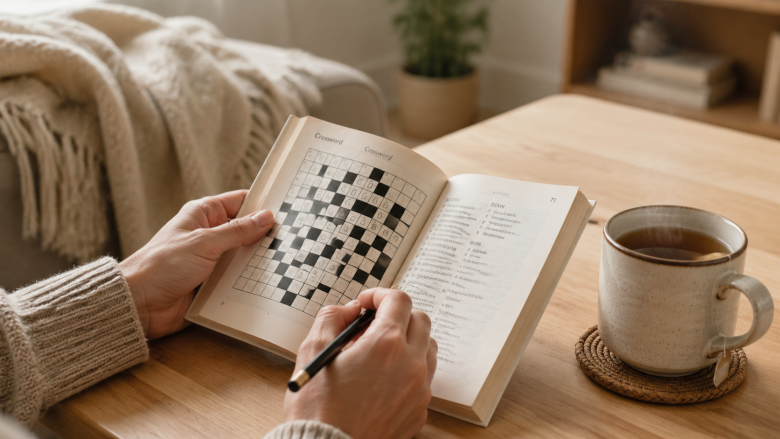
I recommend starting with a specific anchor. For example, use a puzzle book only at the dining table with a cup of herbal tea, never in bed. This creates a spatial boundary that helps your brain switch modes.
Session Length: How Long Is Too Long?
There is a sweet spot for stress-relief puzzling. Under 5 minutes is often too short to shift your mental state. Over 30 minutes can convert a relaxing activity into a productivity task, especially if you start racing to finish the page.
I have found that 10-15 minutes is ideal for most states, with a hard cap of 20 minutes for mental fatigue reasons. Set a silent timer on your phone and place it face down. When the timer goes off, close the book mid-page. Do not finish the puzzle. This is critical because it teaches your brain that the activity has a defined end, which makes it easier to start the next session.
For a deeper dive on structuring your day with small, deliberate activities, see our guide to quick stress reduction in daily life.
The Pre-Sleep Wind-Down
Using a puzzle book before bed is one of the most effective alternatives to screen time. But you have to choose the right kind. Avoid anything too stimulating, like cryptic crosswords or complex logic puzzles. They activate the task-positive network in your brain, which is the opposite of what you want before sleep.
What works is a low-arousal, repetitive puzzle like a simple word search or a color-by-number. One client I worked with told me she kept a large-print word search on her nightstand. She does one row of words only, then puts it down. Within a week, she reported that the simple act of finding five words became a cue that her body associated with sleep. It took about 10 nights to create that association.
The thing nobody tells you: you cannot force this ritual to work immediately. It takes repetition. If you do it for three nights and feel no different, that is normal. The effect is cumulative. If you measure it after 10 days, you will notice the difference.
Using Puzzles as a Work Break
You can also use puzzle books to punctuate your workday. This works best when you are feeling scattered or after a high-intensity meeting. Do not check your phone during your break. That continues the same cognitive load. Instead, do a 5-minute maze.
The reason this works is that a maze requires a shift from verbal reasoning (which you use all day in emails and calls) to spatial reasoning. This shift gives your verbal brain a chance to rest. After the maze, you return to work with a clearer head. For more ways to manage screen-time stress, you might find our daily tips to ease screen time stress useful.
Setting: Where You Puzzle Matters More Than You Think
Most people puzzle in bed or on the couch. That is not ideal. Your bed should be reserved for sleep. Your couch is where you watch TV and scroll on your phone. If you puzzle in those places, your brain gets mixed signals.
A small dedicated corner, even just a chair with a side table, works much better. You do not need a whole room. You need a physical place that you only associate with calming activities. This is a form of stimulus control, a technique used in cognitive behavioral therapy for insomnia.
Lighting matters too. Bright overhead light is too harsh for the nervous system. A warm-toned lamp is better. If you are doing a puzzle at night, dim the lights and use a warm bulb. The shift in color temperature signals to your brain that the day is ending.
For a structured approach to your overall environment, consider the principles in our weekly self-care routine guide, which covers how to design your space for calm.
How to Choose the Right Puzzle Book (A Complete Checklist)
Choosing a puzzle book should be as intentional as choosing a book to read. Here is what I check before buying:
- Paper quality: Thin paper that bleeds through with pen is frustrating. Test with a pencil, and if you must use pen, choose books with 60 GSM or heavier paper.
- Answer key position: In a stress-relief book, answers should be in the back, not upside down on the same page. Having to flip back and forth breaks your flow.
- Fonts and number sizes: For word searches, large print is not just for older adults. It reduces eye strain, which keeps your body relaxed.
- Progressive difficulty: A good book should start easy and ramp up slowly. If page one is a brain-burner, the editor did not design for relaxation. Most stress-relief puzzle books state this in the intro.
- Single-puzzle pages: Avoid books with two puzzles per page unless they are printed landscape. You want to avoid the clutter of seeing another grid while you work.
Most people do not realize that the physical book itself matters. A spiral-bound book lies flat, so you do not have to hold it open with one hand. That frees your other hand for the pencil and lets your posture stay relaxed. A glued book that snaps shut every few minutes is a silent stressor.
Where to Find High-Quality Stress-Relief Puzzle Books
Your local bookshop will have a puzzle section, but the best selection is usually online. Look for books with a style called "dry erase" if you want to reuse pages, though this requires using only dry-erase markers. Alternatively, buy a book that you can tear pages out of. Tearing out a completed puzzle and throwing it away is oddly satisfying and gives you a physical sense of releasing stress.
There are also now subscription services that deliver a new puzzle booklet each month. The benefit of a subscription is variety. You are forced to try different formats, which is how you discover which type matches your stress signature. I recommend trying at least one new format per month. If you always do only word searches, your brain gets accustomed and the stress-reducing effect diminishes over time.
When a Puzzle Book Is the Wrong Tool
I want to be honest about the limitations. A puzzle book is not a treatment for clinical anxiety or depression. If your stress is constant, or if you feel anxious every time you are not distracted, that is a sign you might need professional support. Puzzles are a tool for management and prevention, not a cure.
Also, there are moments when a puzzle book will not help. If you are in acute panic with physical symptoms like chest tightness or hyperventilation, you need a grounding technique first, not a puzzle. The puzzle can come after the wave passes.
Similarly, if you are a highly competitive person, puzzle books might backfire. If you find yourself racing to finish, checking the answer key to see if you did it faster than "expected," or feeling irritated when you make a mistake, you are turning the tool into a stressor. In that case, try a format that is harder to turn into a competition, like color-by-number, where there is no "correct" answer.
Finally, a puzzle book will not replace exercise, sleep, or social connection. It works best as part of a broader stress-management routine. If you want to know where your stress levels currently sit, you can use our stress level score calculator to get a baseline before you start a puzzling practice.
The Bottom Line: Match the Puzzle to the Moment
The next time you feel stressed, resist the urge to automatically reach for the hardest puzzle in your collection. Instead, take that 30-second body scan. Ask yourself: am I scattered, stuck, or depleted?
If you are scattered, a word search will give you quick wins. If you are stuck, a maze will interrupt the thought loop. If you are depleted, a dot-to-dot will let you rest without demanding performance.
This one adjustment - matching the puzzle to your state - will change how you use puzzle books forever. It takes the activity from passive distraction to active, intentional self-care. That is the difference between killing 20 minutes and actually relieving stress.
Pick up a pencil, pick the right page, and let the puzzle do its job.